
What does a Game Programmer do?
Game programmers build the systems and functionality that make a game run. They write code that controls everything from physics and artificial intelligence to audio, rendering, networking, and tool development. Game programmers are generalists who may work across many different areas of a project, or gradually specialise over time into roles such as gameplay programming, engine programming, AI programming, graphics programming, or tools programming. In Australia, the sector is growing, with the 2024 IGEA Australian Game Development Industry Snapshot reporting 2,465 full-time employees across 137 studios, with programmers and engineers being the most in-demand role category.
An example day: Game Programmer
A game programmer typically starts the day at a standup meeting, where the team reviews what was completed, what is planned, and any blocking issues. They then spend the majority of their day writing, testing, and debugging code. This might involve implementing a new feature requested by the design team, fixing a bug identified in QA testing, or optimising a system that is causing performance problems. Programmers read through design documentation, ask clarifying questions, and often prototype systems quickly to validate ideas before a full implementation. They use version control to manage their work and participate in code reviews with peers.
9:00 AM
Check the bug tracker for any overnight submissions from QA; prioritise critical issues for the day
9:30 AM
Team standup — report status on the inventory system, flag a dependency on the save system that needs resolution
9:45 AM
Begin implementing the item stacking logic in C++: write the function, test it in the editor with dummy data
12:00 PM
Lunch break
1:00 PM
Code review session: review a colleague’s pull request for the UI controller changes; leave comments on two functions
2:00 PM
Fix a bug flagged by QA where the player’s inventory would corrupt on save if more than 99 items were stored; write a regression test
3:30 PM
Meeting with the game designer to clarify requirements for the crafting system: discuss edge cases and update the task breakdown in JIRA
4:30 PM
Write unit tests for the stacking function; commit working code to Perforce with documentation comments
5:15 PM
Brief scan of the Unreal Engine developer forums for a thread on performance profiling relevant to next week’s optimisation sprint
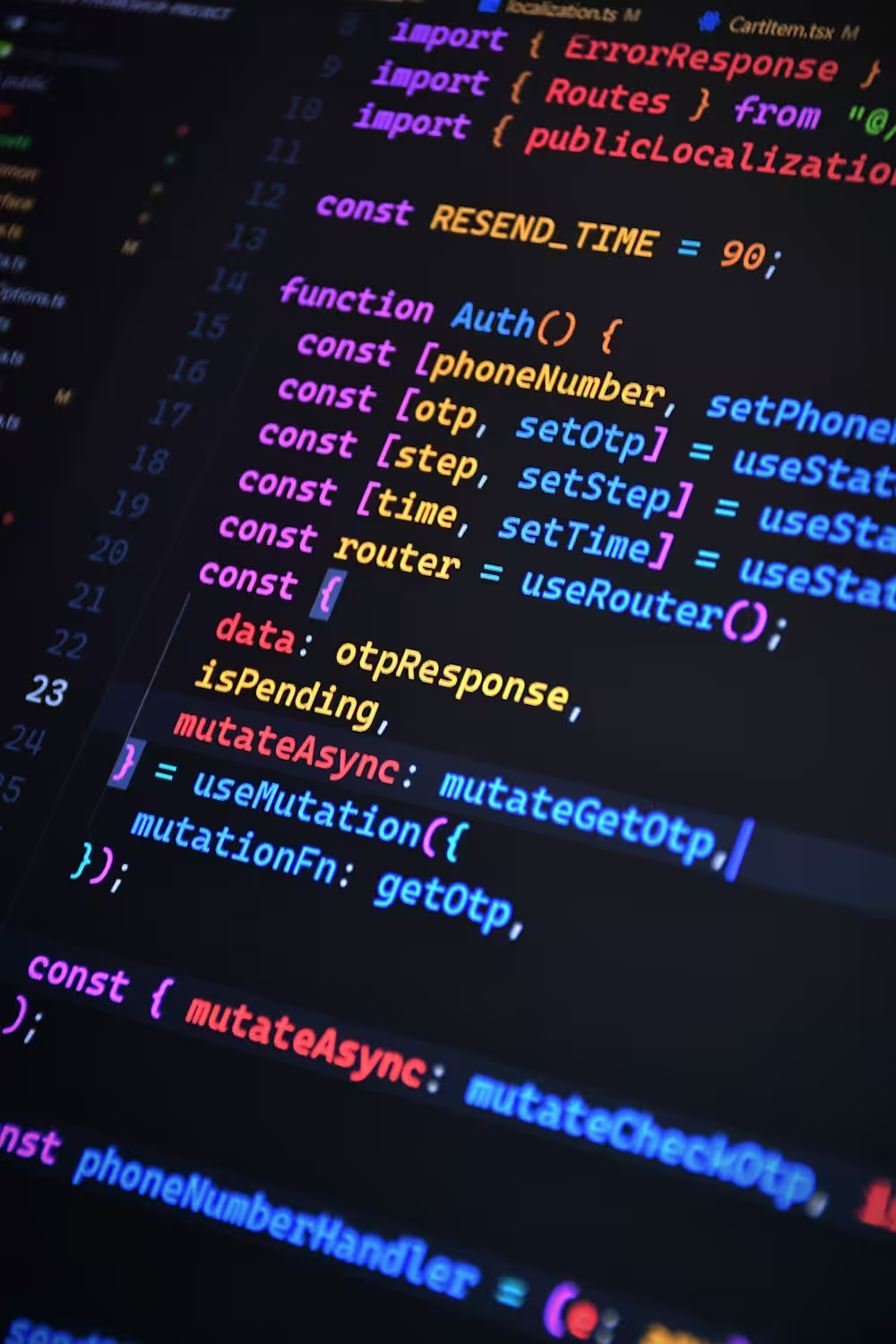
What should I be able to do as a Game Programmer?
Skills
- Write clean, efficient C++ and/or C# code for game systems
- Debug and profile game code to identify and fix performance issues
- Implement game features from design documents
- Use version control systems with discipline
- Collaborate and communicate technical constraints to non-programmers
- Participate in code reviews and maintain code quality standards
- Write unit tests and basic documentation for the systems you build
Knowledge
- C++ and C# programming languages
- Data structures, algorithms, and software design patterns
- Game engine architecture (Unity or Unreal)
- Mathematics: linear algebra, vectors, matrices as applied to games
- Memory management and performance optimisation for real-time applications
- Software development lifecycles and Agile methodologies
- Platform-specific constraints for PC, console, and mobile
Typical salaries for Game Programmer in Australia
All salaries are approximates based on recently advertised positions in Australia.
$0k
Entry-level (0–3 years)
$0k
Mid-career (4–9 years)
$0k
Senior (10+ years)
Software used by Game Programmer
The software used by Game Programmers is highly specialized. The more platforms you are trained in, the more valuable you will be to an employer. Game Programmers may need knowledge of a combination of the following software.

Visual Studio for programming

Unreal Engine for Unreal Engine
Game development

Unity Engine for Game Development

Perforce for project management and version control

Git for project management and version control

Open GL for low-level graphics programming

Open-source Libraries for public code-bases commonly used throughout programming industries
How to get a job as a Game Programmer
- Build and release small games on Steam, itch.io, or app stores
- Contribute to open-source game projects on GitHub
- Complete coding challenges and build a clean, well-documented GitHub portfolio
- Participate in game jams to show the ability to ship under time pressure
- Network at Australian industry events such as GCAP
- Get familiar with one engine deeply rather than superficially knowing many
AIE courses for Game Programmer
Do you have what it takes to be a Game Programmer?
Read the points below and if these sound like you, Game Programmer could be a great option!
- You enjoy solving logic problems and puzzles. Game programmers spend their days diagnosing and solving complex technical problems.
- You have written code before, even informally — Python, Scratch, a game mod, or something in a game engine.
- You liked maths at school, particularly algebra, geometry, and problem-solving.
- You are methodical and patient. Debugging complex code requires checking assumptions carefully and working through possibilities systematically.
- You enjoy understanding how things work under the surface. You are not satisfied with just using an app; you want to know how it was built.
- You are comfortable with abstract thinking. Programming requires holding complex systems in your head and reasoning about them.
- You enjoy making things that other people interact with, even if that work is invisible in the final product.
Programming ability can be built from very little prior experience. What matters most is the underlying disposition: a love of problem-solving, comfort with abstraction, and patience with complexity.
Hear from Game Programmers
The Best of 2024...

AI & Technology – What it means for...
What does a Graduate Software Developer do? Hear...
Welcome to 2024 with AIE...
Women in Games with AIE...
Junior Programmer: AIE with Sian Sallway...
VET in Schools: AIE with Heidi Borge...
Maps, Meshes And AI, Oh My: AIE with...
Meet the Indie Devs: Mini Mammoth Games...
Meet the Art Director: Oscar Berman...
Student Takeover: Game Major Project...
Meet the Immersive Systems Engineer: Nicola Best...
Meet the Future Experts: Jazmin Fazzolari-Dusik & Victoria...
Meet the AR/VR Expert: Connor Gibson...
My Journey Becoming a Unity Developer – Patrick...
My Journey Becoming a 2D Game Artist –...
My Journey into AAA Games Development – Ben...
My Journey into Game Programming – Bertrand Thomachot...
How to get started as a Game Programmer
- Bachelor of Game Development (Major in Game Programming) – AIE Institute (CRS1400953)
- Advanced Diploma of Professional Game Development (Game Programming) – AIE (11151NAT)
- Game Development Foundations – Certificate III in Information Technology (ICT30120)
Upcoming Events
Discover more at one of our events
AIE runs campus and online events throughout the year and we encourage students to attend. AIE also broadcast regular livestreams with our alumni and industry professionals that provide insight into future career paths.
Open Day
November 21, 2026
Discover the courses designed to get you started in game development, 3D animation and visual effects at the AIE Open Day. Find out about full-time and part-time courses starting soon.
Starts at 10am
Roles related to Game Programmer in the industry
Find out more
Download our course guide to see how we can help you on your pathway to your dream career.
Get Your Course Guide and Take the First Step
There’s a lot more to explore in the full course guide, and our admissions team will be there to help if you have any questions.
"*" indicates required fields