

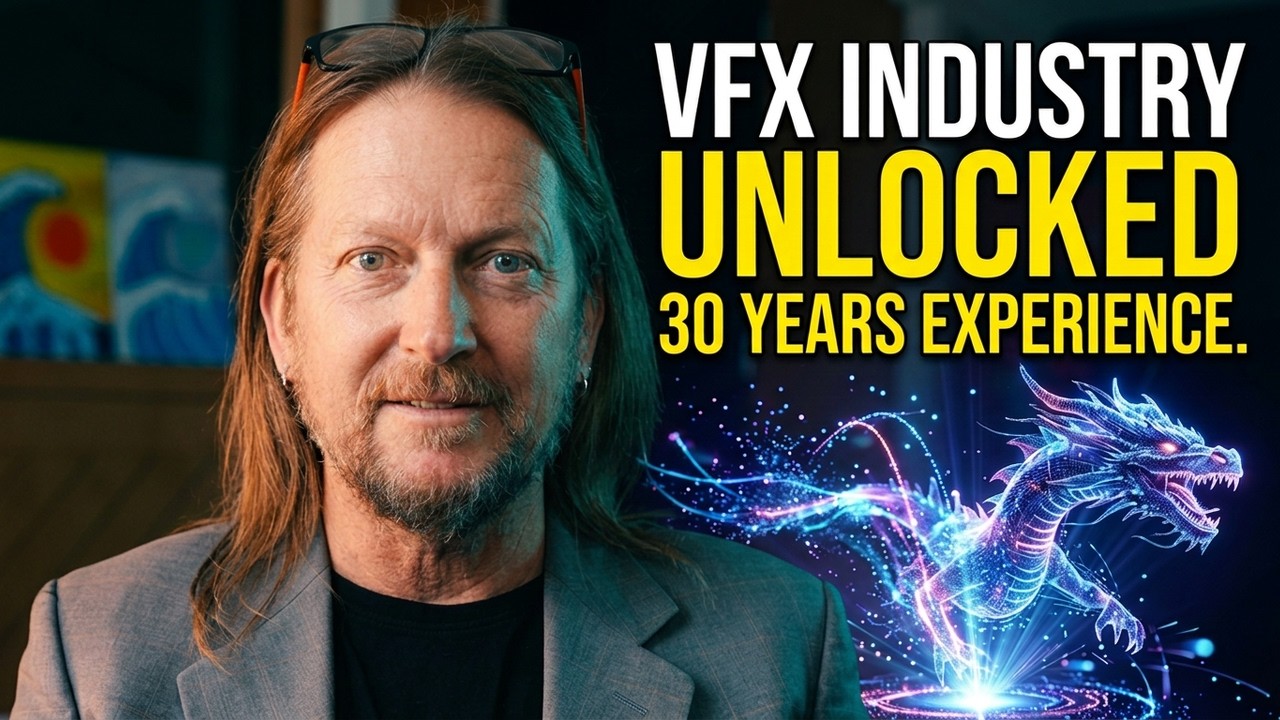
Few careers mirror the evolution of the visual effects industry as closely as that of Lars Magnus Holmgren. Today, as a 3D Animation and VFX Trainer at the Academy of Interactive Entertainment (AIE), Holmgren brings more than three decades of experience spanning broadcast design, feature films, commercials, games cinematics, visual effects supervision, creative direction and education. His journey from Sweden to Australia, and eventually onto some of the world’s most prestigious productions and studios, offers students a rare glimpse into the history and future of digital storytelling.
Trading Ice Skates for a Surfboard
Holmgren’s story begins in Sweden, where he spent his early years before his family emigrated to Sydney, Australia.
“I traded my ice skates for a surfboard,” he jokes.
The move would prove pivotal. Drawn to visual arts and creative expression, Holmgren pursued six years of tertiary education, earning a Diploma in Fine Arts and Design before completing a Bachelor of Arts in Visual Communication at the University of Technology Sydney. His studies combined artistic foundations with emerging digital technology. He graduated with distinctions, majoring in Computer Graphics and minoring in Film.
Outside academia, his creative interests stretched far beyond design. He played in bands throughout his school years and into his twenties, participated in performance art collectives, and became involved in multimedia exhibitions. Those experiences would later influence his philosophy that animation is ultimately about performance, rhythm and storytelling.
Entering the Industry at the Dawn of Digital
Holmgren entered the CGI industry in 1991, joining Sydney-based post-production studio Conja. At the time, Australia’s digital effects scene was still in its infancy.
“The north side of Sydney Harbour Bridge was really where much of the action was,” Holmgren recalls. “Studios like Garner McLellan, Animal Logic and Conja were pioneering this transition into digital production.”
The environment demanded adaptability. Most projects involved broadcast television promotions, station idents and commercials, all operating under aggressive delivery schedules.
“You learned to think laterally very quickly when online deadlines were involved.”
Starting as a Junior Broadcast Designer, Holmgren progressed through the ranks over seven years, eventually becoming Head of CG. During those formative years he witnessed one of the industry’s greatest technological revolutions: the shift from analogue post-production to fully digital pipelines.
Witnessing the Birth of Modern Visual Effects
For younger artists accustomed to real-time rendering and cloud-based workflows, the technology of the 1990s can seem almost prehistoric.
Holmgren remembers working with industry-defining systems such as Paintbox, Henry, Harry, Illusion, Flame and Inferno. These massive systems required dedicated cooling rooms and ran on expensive Silicon Graphics (SGI) hardware.
“Back then 3D Studio Max was basically the only serious PC option,” he says. “We had around 512 megabytes of RAM. Broadcast resolution was 720×576 and film work often started around 2K.”
He was also among the first artists to experiment with technologies that would later become industry standards.
“I had the opportunity to test-drive one of the first beta versions of Maya.”
Guided by mentors including a visual effects supervisor from Industrial Light & Magic (ILM), Holmgren’s technical pathway evolved from Paintbox to Alias, Alias/Wavefront and eventually Maya, mirroring the wider industry’s progression.
He notes that visual effects itself looked very different during that era.
“Originally VFX was primarily a post-production discipline. Today it spans the entire production pipeline, from concept development and previsualisation through to final delivery.”
The Director Emerges
By the late 1990s, while waiting for lengthy render times to complete, Holmgren began sketching characters and developing narrative concepts.
What started as a creative outlet soon became something much bigger.
“I’d spend hours concepting while renders were running. Some of those ideas evolved into projects that became my creative banner, Frankenskippy.”
Among these projects was Tall Small Stories, a trilogy that included Frankenskippy, a distinctive animated work that achieved international recognition.
The success of these projects marked the birth of Holmgren’s parallel career as a director while continuing his work as a visual effects artist and supervisor.
From Australia to the World Stage
Following freelance work between Sydney and Melbourne in 1998 and 1999, Holmgren’s career rapidly expanded internationally.
His MTV-commissioned work attracted attention at festivals worldwide, including SIGGRAPH in Los Angeles. The acclaim led to interviews with both ILM and Tippett Studio during a trip to San Francisco.
One memory stands out.
“I found myself sitting just a table away from George Lucas at Skywalker Ranch.”
Soon after, Holmgren travelled to London, where he interviewed at several studios before accepting a role at The Moving Picture Company (MPC), one of the world’s leading visual effects facilities.
The move launched an international career that would see him work across London, New York, Stockholm, Berlin, Düsseldorf and Los Angeles.
Building a Global Reputation
Over the following decades, Holmgren held leadership positions at many of the industry’s best-known studios, including MPC, Double Negative (DNEG), Buck, Prime Focus, Plastic Wax, Flying Bark, Locomotion, Vandal, Rising Sun Pictures and numerous others.
His projects have ranged across feature films, episodic television, game cinematics, documentaries, IMAX attractions, commercials and music videos.
Along the way, he developed a reputation for combining artistic creativity with deep technical expertise.
As a VFX Supervisor, Animation Director, Head of 3D and Creative Director, Holmgren has managed teams ranging from small specialist groups to productions involving more than 100 artists. He has consistently emphasised the importance of communication, mentorship and collaboration.
“Technology changes constantly, but teamwork remains the most important skill in any successful production.”
Beyond Visual Effects
Despite an extensive professional career, Holmgren’s creative pursuits have never been limited to commercial production.
He has collaborated with internationally recognised artists, including Liam Gillick, contributing to projects associated with the opening of the Clore Gallery at Tate Britain.
His digital artwork, photography, installations and films have appeared in exhibitions and urban showcases across New York, London, Miami, Las Vegas and Los Angeles.
Meanwhile, his independent filmmaking continues to receive international recognition, with numerous festival awards spanning visual effects, directing and short-form storytelling.
Among his achievements are three Silver Lions at Cannes and a long list of awards from international film festivals, visual effects competitions and creative industry events.
The Link Between Martial Arts, Dance and Animation
One of Holmgren’s most interesting perspectives involves the connection between physical movement and digital performance.
A long-time practitioner of martial arts and dance, he believes both disciplines directly inform animation.
“Animation is all about performance. You’re acting through a character. Understanding movement, rhythm, weight and intention helps you create believable performances.”
It’s an approach that reflects his broader creative philosophy: technology is simply a tool, while observation, storytelling and human behaviour remain the foundations of great animation.
Giving Back Through Education
After decades at the forefront of the industry, Holmgren has increasingly focused on education and mentoring.
Having previously taught at institutions such as Billy Blue College of Design and JMC Academy, he now brings his experience to the Academy of Interactive Entertainment.
For students, the value is obvious. Holmgren isn’t simply teaching software. He has lived through every major industry transition, from analogue post-production to AI-assisted workflows.
His experience covers the entire spectrum of production, from storyboards and concept design to visual effects supervision, animation, compositing, directing and final delivery.
Most importantly, he understands what studios are looking for.
“I want students to understand both the artistic and technical sides of the craft. The industry’s always evolving, so the ability to learn, adapt and collaborate is what ultimately creates long-term success.”
Looking Forward
Lars Holmgren’s career reflects the remarkable evolution of digital storytelling over the past 35 years. From operating Paintbox systems in Sydney’s early broadcast industry to supervising international VFX teams and directing award-winning productions, he has continually adapted to new technologies while remaining grounded in creativity and communication.
Now, as an educator at AIE, he is helping prepare the next generation of artists to enter an industry he helped shape.
For students interested in animation, visual effects and digital production, few mentors can offer a perspective that spans so much history, innovation and hands-on experience. Lars Holmgren isn’t just teaching the industry. He’s lived it.